
Understanding AI: Tools, Uses, and Possibilities.
Artificial intelligence is already transforming the way we work, communicate, create, and solve problems. From automation and virtual assistants to healthcare, education, marketing, and everyday technology, AI is becoming part of nearly every industry. Learn how it is being used today, where it is heading, and what the growing role of intelligent technology could mean for businesses, society, and the future.
- How AI Works
- How AI Is Being Used
- What AI Means for the Future
Masters
TECHNOLOGY
THE TECHNOLOGY BEHIND THE HEADLINES
AI Didn’t Suddenly Appear in 2022
ChatGPT introduced millions of people to generative AI, but the underlying research stretches back decades. The story is a chain of ideas: rules → machine learning → neural networks → deep learning → transformers → large language models → retrieval → tools → agents. Each layer builds on earlier work—and gives computers new ways to recognize patterns, use information, and act.
A short history of artificial intelligence
75+ Years of AI: From Mathematical Theory to AI Agents
1950
Can machines think?
1956
AI becomes a named research field
1957–1958
The Perceptron
1960s–1970s
Rules and symbolic AI
1980s
Neural networks return to focus
1997
Deep Blue beats Kasparov
2012
AlexNet and GPU-powered deep learning
2016
AlphaGo beats Lee Sedol
2017
“Attention Is All You Need”
2018–2020
Transformers scale up
2022
Conversational AI reaches the public
2023–2025
A broader model race
2026
An ongoing chapter
The basic idea
So What Exactly Is an AI Model?
TRADITIONAL SOFTWARE
↓
RULES WRITTEN BY A PROGRAMMER
↓
OUTPUT
AI MODEL
↓
MODEL PARAMETERS ADJUSTED TO LEARN PATTERNS
↓
NEW INPUT → PREDICTION OR GENERATION
A practical field guide
AI Terms
AI comes with a lot of buzzwords—models, tokens, agents, RAG, inference, context windows, GPUs, and plenty more. They can sound more complicated than they really are. Cut through the jargon and find out what these terms actually mean, how they relate to one another, and why they matter.
Definition: A large language model is a neural network trained on text and other data to model language patterns and generate outputs.
Think of it as: A remarkably well-read prediction engine—not a database that guarantees truth.
Why it matters: LLMs power much of today’s conversational AI.
Definition: Retrieval-augmented generation (RAG) retrieves relevant information from selected sources and supplies it to a model when it answers.
Think of it as: Letting an open-book test-taker consult the library.
Why it matters: RAG can ground responses in current or organization-specific material, though retrieval and generation can still fail.
Definition: Model Context Protocol (MCP) is an open protocol for connecting AI applications to external tools and data sources.
Think of it as: A standard plug shape that helps compatible apps and services communicate.
Why it matters: A shared connection pattern can reduce one-off integrations; it does not itself grant safe access.
Definition: An AI agent uses a model to pursue a goal through a loop of planning, tool use and checking results.
Think of it as: A capable assistant following a checklist with approved tools.
Why it matters: Agents can handle multi-step tasks, but require permissions, guardrails and human oversight.
Definition: Tokens are chunks of text or other input that a model processes; a token may be a whole word, part of a word or punctuation.
Think of it as: Pieces in a language puzzle, not a one-to-one word count.
Why it matters: Tokenization affects context limits, latency and many API prices.
Definition: A context window is the amount of input and generated content a model can consider in one request.
Think of it as: The working space on a desk during one task.
Why it matters: More context can hold more material, but does not guarantee perfect recall or understanding.
Definition: Training adjusts a model’s parameters using data and an optimization process so it learns patterns useful for a task.
Think of it as: Repeated practice that changes the system’s internal settings.
Why it matters: Training creates the model; it is different from asking the already-trained model a question.
Definition: Inference is the process of using a trained model to produce an output for new input.
Think of it as: Taking the exam after practice.
Why it matters: Inference is what happens when a chatbot responds, a model labels a photo or an agent calls a tool.
Definition: A multimodal AI system can process or generate more than one kind of input or output, such as text, images, audio or video.
Think of it as: A system with more than one sense or medium.
Why it matters: People communicate across media; multimodal models can work with richer real-world material.
Definition: Quantization stores or computes model values at lower numerical precision than a higher-precision representation.
Think of it as: Using a compact shorthand that takes less room.
Why it matters: It can reduce memory and compute needs, with trade-offs that vary by model, quantization method and task.
One picture, four useful ideas
AI Systems: A Human Analogy
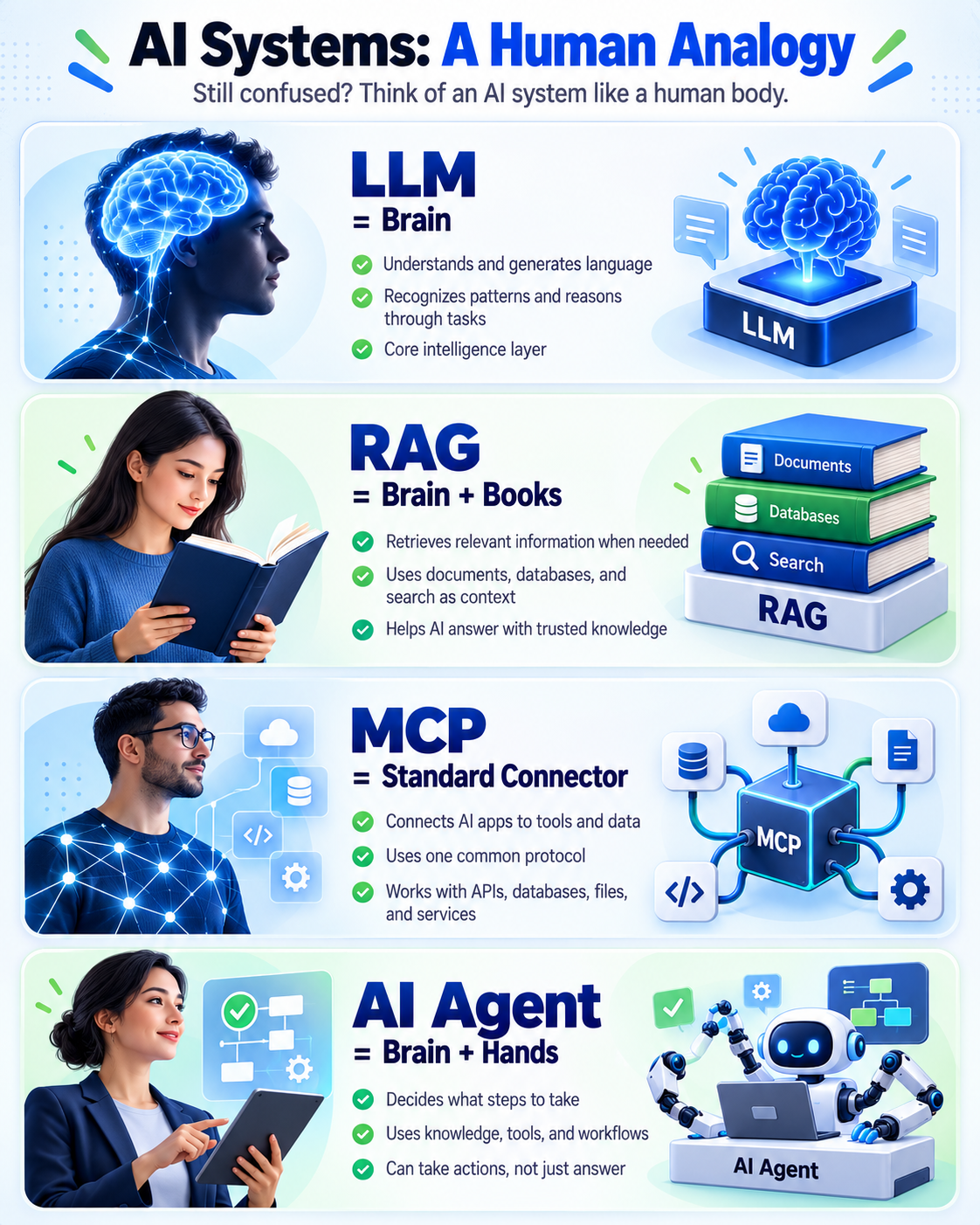
THE BRAIN · LLM
THE BOOKS · RAG
THE CONNECTION · MCP
THE HANDS · AGENT
The hardware behind the answers
Why GPUs Became the Engine of AI
CPU · GENERAL-PURPOSE
→
GREAT FOR SEQUENTIAL TASKS & COORDINATION
GPU · PARALLEL WORK
→
GOOD AT MANY SIMILAR CALCULATIONS AT ONCE
What happens when you send a prompt?
01 INPUT →
Text becomes tokens
02 COMPUTE →
Model runs inference
03 GENERATE →
Tokens appear in sequence
04 OUTPUT →
You receive a response
The names you hear
The AI Model Landscape: Different Labs, Different Approaches
OpenAI
GPT
HOSTED
Anthropic
CLAUDE
HOSTED
Google DeepMind
GEMINI
GEMMA
Meta
LLAMA
OPEN WEIGHTS
Alibaba / Qwen
QWEN
BOTH
Mistral AI
MISTRAL
BOTH
DeepSeek
DEEPSEEK
BOTH
xAI
GROK
HOSTED
Your computer, your model
What Is Local AI?
CLOUD AI
LOCAL AI
From answering to doing
From Chatbot to AI Agent
01 GOAL →
What should be done?
02 PLAN →
Break it into steps
03 TOOL →
Use an approved capability
04 CHECK →
Inspect result, continue or stop
The more an AI system can do, the more carefully we need to decide what it is allowed to do.
Why the excitement?
AI as a Force Multiplier
MAKE A FIRST DRAFT
FIND THE SIGNAL
CONNECT THE STEPS
A healthy dose of skepticism
AI Can Sound Certain While Being Completely Wrong
WHERE AI OFTEN HELPS
Drafting: produce a first pass for review.
Transformation: summarize, reformat or extract.
Pattern work: classify or find themes in material you provide.
WHERE YOU NEED TO CHECK
Freshness: training data may not reflect current events.
Judgment: a model may miss stakes, nuance or context.
Actions: tools can make mistakes at real-world scale.
Why progress feels so fast
The AI Flywheel
01 RESEARCH →
New methods
02 COMPUTE →
Faster hardware & systems
03 PRODUCTS →
More ways to use AI
04 FEEDBACK ↻
New needs & questions
The next chapter is being written
What I’m Watching Next
More useful multimodality
Agents that earn trust
Open and local ecosystems
A note from Dan
Why I’m Following This
I’m a curious builder watching a remarkable technology race unfold and exploring what is actually happening beneath the headlines.
The more I learn, the more I see AI not as magic, but as a stack of ideas, tools and trade-offs that ordinary people can learn to use thoughtfully.
Quick answers
Frequently Asked Questions
Artificial intelligence (AI) is a broad field of methods that let computer systems perform tasks associated with human capabilities, such as recognizing patterns, understanding language, making predictions, or generating content. It does not mean a machine thinks exactly like a person.
It depends on the service and account settings. Some providers may use consumer conversations to improve models unless you opt out; business plans may have different protections. Check the provider’s current privacy and data-use terms before sharing sensitive material—do not assume every chatbot handles prompts the same way.
AI is the broad goal of building systems that perform intelligent tasks. Machine learning is one approach within AI: a system learns patterns from examples instead of relying only on hand-written rules.
Do not enter confidential, regulated, or personally identifying information unless you have reviewed the service’s data-use terms and your organization’s policies. Consider whether prompts are retained, used for training, visible to administrators, or sent to subprocessors. When in doubt, redact or use an approved environment.
Sovereign AI means keeping meaningful control over AI capabilities and their supply chain—such as data, models, infrastructure, operations, and governance—within an organization or jurisdiction. It is broader than simply running a model locally. The exact meaning varies, so check which parts are actually controlled and where data is processed.
Generative AI creates new outputs—such as text, images, audio, video, or code—based on patterns learned during training and the input it receives. The output can be useful, but it still needs evaluation.
No. In a typical RAG system, retrieved passages are added to the model’s input for that request; the model’s trained parameters are not changed. Fine-tuning is a separate training process that can adjust model parameters. RAG can supply newer or organization-specific information, but it does not guarantee a correct answer.
RAG connects a language model to a separate knowledge source. First, documents are prepared and indexed; for a question, the system searches that index for relevant passages, places selected passages in the model’s context, and asks the model to compose an answer from them. RAG can make information easier to update without retraining the model, but retrieval can miss the right passage and the model can still misread or misstate it.
Many AI workloads rely on huge numbers of similar mathematical operations that can run in parallel. GPUs are designed to perform many such calculations at once, while CPUs excel at a smaller number of complex, general-purpose tasks. AI also depends on fast access to model data in memory.
An AI model is a trained set of numerical parameters and computations that transform inputs into outputs. It is not simply a searchable database containing a copy of every training example, though models can sometimes memorize information.
Training adjusts a model using data and an optimization process. Inference is using the trained model to produce a result for a new prompt, image, or other input.
An AI agent uses a model in a goal-oriented loop that may include planning, calling tools, observing results, and taking another step. A chatbot mainly responds in conversation; an agent may act through connected software, but needs permissions, guardrails, and human review.
Local AI runs on hardware controlled by the user or organization, rather than sending every request to a remote AI service. Sovereign AI usually refers more broadly to control over infrastructure, data, and governance within a chosen jurisdiction or organization. The terms do not guarantee privacy or security by themselves.
Cloud AI runs on a provider’s remote infrastructure and is accessed over a network; local AI runs on a device or server you control. Cloud systems can offer convenient access to powerful models, while local systems can offer more control but require suitable hardware and maintenance.
AI is more likely to change tasks and job workflows unevenly than to replace every person or occupation at once. Outcomes depend on reliability, cost, regulation, organizational choices, and the human judgment required. People remain accountable for consequential decisions.
Businesses use AI for tasks such as drafting, search, customer-service triage, document extraction, forecasting, software assistance, and personalization. The strongest results usually come when a clearly defined workflow combines AI with trusted data, automation, and human oversight.
AI can produce confident errors, miss context, reflect bias in data, struggle with inconsistent reasoning, and fail when connected tools or information are unreliable. Important claims, calculations, code, and actions should be checked by a responsible person.
Not automatically. RAG controls which content may be retrieved for a request, but privacy depends on the full design: document permissions, access controls, indexing and storage, provider terms, logging, encryption, retention, and deletion practices. The system should enforce each user’s permissions at retrieval time and be tested so one person cannot receive another person’s documents.