Four small robots, a few unexpected tumbles, and a demonstration that says a great deal about the future of artificial intelligence.
At NVIDIA’s GTC conference in Berlin on October 21, 2026, CEO Jensen Huang shared the stage with four small, duck-like robots developed by France’s Pollen Robotics, part of Hugging Face.
They’re called Microduck, and while they may look more like animated toys than sophisticated machines, the technology behind them represents an important development in artificial intelligence.
These little robots can walk, sit, stand, and perform trained movements. During the demonstration, Huang even asked them to perform somersaults. Not everything went perfectly, which made the presentation entertaining and, in some ways, more revealing.
But the really interesting story isn’t about robotic ducks doing tricks.
It’s about how artificial intelligence is learning to move from computer simulations into the physical world.
Meet Microduck: Small Robot, Big Ambitions
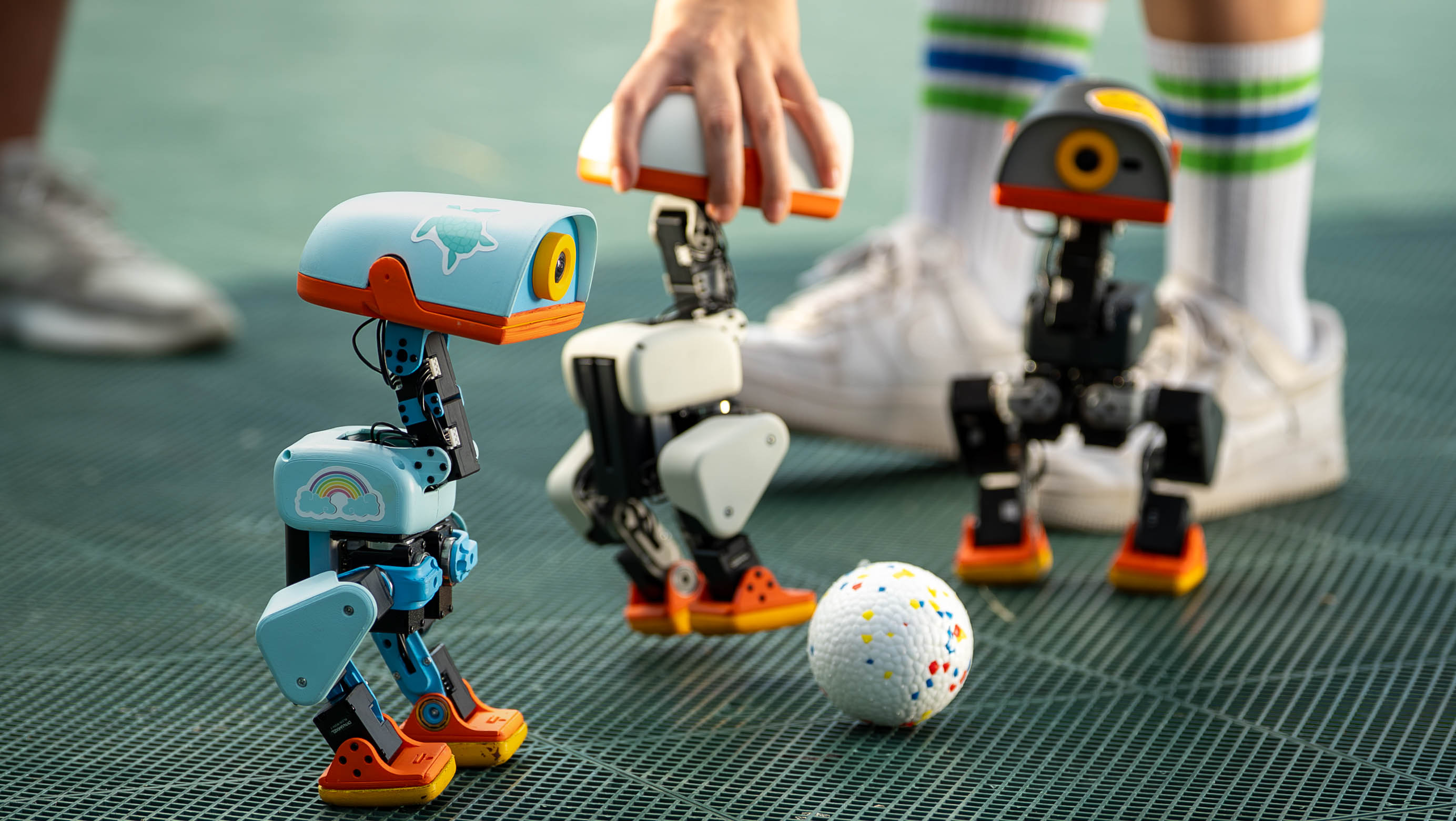
Microduck is a compact, programmable bipedal robot developed by Pollen Robotics, the Bordeaux-based robotics company that joined Hugging Face in 2025.
Standing approximately 25 centimeters tall—just under 10 inches—Microduck contains an impressive collection of hardware:
- 15 motors controlling its articulated movements
- A camera for visual input
- LiDAR and motion sensors for understanding movement and surroundings
- A movable beak capable of grasping objects
- Onboard computing and wireless connectivity
- A rechargeable battery and programmable software environment
The introductory price is $399, before taxes and shipping. As of October 2026, preorders are open, with initial deliveries targeted before Christmas.
Perhaps most importantly, the robot is built around an open-source software ecosystem that allows developers to experiment with its behavior.
That makes Microduck more than a novelty.
It’s a platform for learning how intelligent machines can interact with the real world.
What Jensen Huang Actually Demonstrated
One of the most interesting parts of Huang’s presentation was the process behind the robot’s movements.
NVIDIA demonstrated how an AI agent could help prepare a robot-training task, create a simulated environment, and evaluate the robot’s behavior before transferring what it learned to actual hardware.
The process involved NVIDIA Isaac Sim, cloud-based training resources, and an RTX Spark system used for evaluation and deployment.
This approach is known as simulation-to-reality, often shortened to sim-to-real.
Instead of teaching a robot every movement manually, developers can train a movement policy inside a physics simulation.
The simulated robot can practice repeatedly without damaging expensive hardware, wearing out mechanical components, or requiring someone to physically reset it after every mistake.
Once a behavior is sufficiently reliable, the trained policy can be transferred to the real robot.
The four Microducks that joined Huang onstage illustrated what this process can produce.
And when their movements didn’t go precisely as expected, they also demonstrated an important reality: robots still have to contend with balance, timing, physical forces, and unpredictable circumstances.
Those are challenges that software-only AI systems don’t encounter in quite the same way.
Physical AI: The Next Step Beyond Chatbots
Most people experience artificial intelligence through a conversation.
We ask ChatGPT a question, request an image, generate software code, or ask an AI assistant to help complete a task.
But physical AI adds another layer.
It connects digital intelligence with cameras, sensors, motors, and physical environments.
There are several important parts to this transition.
Perception: The system collects information through cameras and other sensors.
Reasoning and planning: AI models or other algorithms interpret information, select objectives, and help determine what should happen next.
Control: Trained movement policies and control software translate objectives into physical actions.
Learning: Simulation and training allow the system to improve particular behaviors before they are deployed on real hardware.
These functions don’t necessarily come from a single AI model. In fact, the most capable systems often combine specialized components.
This is one reason the Microduck demonstration is interesting.
It shows how multiple technologies can cooperate to produce something that looks relatively simple: a little robot that can stand up and move around.
Why Open-Source Robotics Matters
One of the biggest obstacles to developing robotics has traditionally been the cost and complexity of getting started.
Building hardware is expensive. Testing movement algorithms can be difficult. And sophisticated simulation and training tools have often been associated with universities, research laboratories, and major technology companies.
Pollen Robotics is trying to make that process more accessible.
Microduck’s planned software ecosystem includes an open-source SDK, simulation environments, reinforcement-learning tools, and workflows for transferring trained behaviors onto the robot.
Developers will be able to study existing movement policies, modify them, and experiment with creating new ones.
An important distinction: Microduck’s software stack is open source, but Pollen Robotics does not describe its mechanical and electronic design files as open-source hardware.
Nevertheless, opening the software side creates opportunities for experimentation and collaboration.
A developer who wants to understand how a robot learns to balance could work with the simulator rather than beginning by engineering an entire machine from scratch.
That’s a meaningful step toward making physical AI accessible to a broader community.
The Connection Between Local AI and Robotics
At WebGuruMasters, one of the developments we’re watching most closely is the growth of local and sovereign AI.
These systems allow businesses and developers to run appropriate AI models on infrastructure they control, rather than sending every request to a remote cloud provider.
The Microduck demonstration offers an interesting example of how local and cloud resources can complement one another.
Training a robot’s movement policy can require significant computing resources, making cloud infrastructure useful.
But executing that learned behavior requires reliable, responsive control.
Those are different computational challenges.
A practical architecture may use cloud systems for computationally intensive training, local computers for development and evaluation, and onboard processors for time-sensitive control.
The takeaway is not that everything should run locally—or that everything belongs in the cloud.
It’s that intelligent systems should use the right computing resources for each job.
The same principle applies to business AI systems.
Some tasks can be handled by local language models, while others may benefit from external services, specialized tools, or larger models.
A well-designed system can coordinate those resources while maintaining appropriate security, access controls, and human oversight.
What Does This Mean for Small Businesses?
It’s reasonable to ask what a small robotic duck has to do with running a business.
Probably more than you might initially think.
The underlying technologies—AI agents, intelligent routing, simulation, connected systems, and autonomous execution—have applications that extend well beyond robotics.
Consider customer relationship management.
Today, many businesses use a CRM to store contacts, track conversations, and send automated messages.
With carefully designed AI integrations, those systems can become more capable of interpreting incoming information, recommending next steps, and carrying out approved workflows.
Or consider website management.
An AI agent could help monitor website performance, identify errors, prepare updates, and assist with routine maintenance.
These aren’t physical robotics applications, but they rely on a related concept: connecting intelligence to tools that can perform useful work.
The robot is simply a particularly visible demonstration of that idea.
Why We’re Following This at WebGuruMasters
At WebGuruMasters, we work at the intersection of websites, hosting, customer relationship management, marketing automation, and emerging AI technologies.
We’re particularly interested in developing systems that combine local AI models, useful business integrations, and practical automation.
The goal isn’t to replace people with technology.
It’s to eliminate repetitive work, make business systems more capable, and give people better tools to accomplish their objectives.
That’s why developments like Microduck deserve attention.
Not because every business needs an autonomous robot on its desk, but because the technologies behind it are becoming more accessible.
The same progression that brought sophisticated AI models to personal computers is beginning to influence robotics and physical automation.
And the more accessible these tools become, the more opportunities there will be for independent developers and smaller businesses to experiment.
The Future of AI Won’t Stay Behind a Screen
Jensen Huang’s Microduck demonstration was entertaining.
Four small robots performed for an audience, occasionally with results that weren’t quite what their presenter expected.
But underneath the humor was a serious technological milestone.
AI tools helped develop behaviors in simulation. Training resources helped produce movement policies. Those policies were evaluated and deployed to actual robots.
It’s an example of how software intelligence is beginning to connect more closely with the physical world.
There are still substantial challenges involving reliability, safety, generalization, and cost. A robot successfully performing trained movements is not the same thing as a machine capable of understanding and completing any physical task.
Nevertheless, the direction is becoming clearer.
We’re moving from AI that can generate information toward systems that can interact with software—and increasingly, with the world around them.
The next revolution in AI may not be about what machines can tell us. It may be about what they can learn to do.
At WebGuruMasters, that’s the evolution we’re paying attention to.